We often hear about the VUCA world—volatility, uncertainty, complexity, and ambiguity—as if it’s a new challenge. But as Warren Buffett wisely noted, all times are, by definition, uncertain. The problem isn’t the uncertainty; it’s our outdated response to it. We aim for resilience, systems that merely withstand shocks. Yet, in seeking stability, we often create fragility, much like a perfectly planned structure that hides accumulating stress until it catastrophically collapses.
Nassim Taleb’s concept of Anti-Fragile offers the necessary paradigm shift. Anti-fragile systems don’t just endure shocks; they improve because of them.
- Fragile: Breaks easily (e.g., a finely tuned process that collapses under unexpected load).
- Resilient: Withstands stress but remains the same (e.g., a strong wall that survives a storm).
- Anti-Fragile: Gains from disorder (e.g., a muscle that grows stronger only when stressed).
As Gary Hamel and Lisa Valikangas argued, organizations clinging to stability are creating a dangerous “resilience gap,” accumulating risks that turn predictable disruptions into organizational disasters.
Step-by-Step Reasoning: Why Talent Management is the Weakest Link
The conventional practices of Talent Management (TM) are, ironically, often the most fragile elements of the business structure. They are typically siloed and ritualistic—processes performed for their own sake, not for real-world impact.
1. The Succession Planning Illusion
Our current approach, relying on meticulously crafted organograms and annual reviews, is little more than a paper exercise. It is utterly detached from reality. It prepares us for a predictable future that never arrives and leaves us blind to “black swan” events—the radical, unpredictable shocks like sudden technological obsolescence, pandemic shifts, or competitor disruption. When these events hit, the fragility we’ve accumulated in our planning is exposed.
2. The “Snakes and Ladders” Metaphor
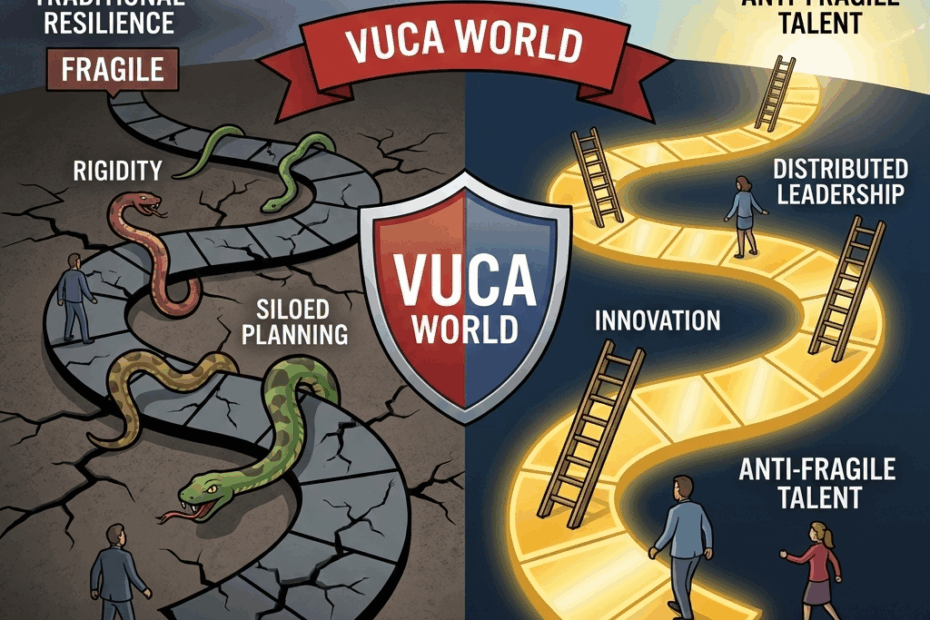
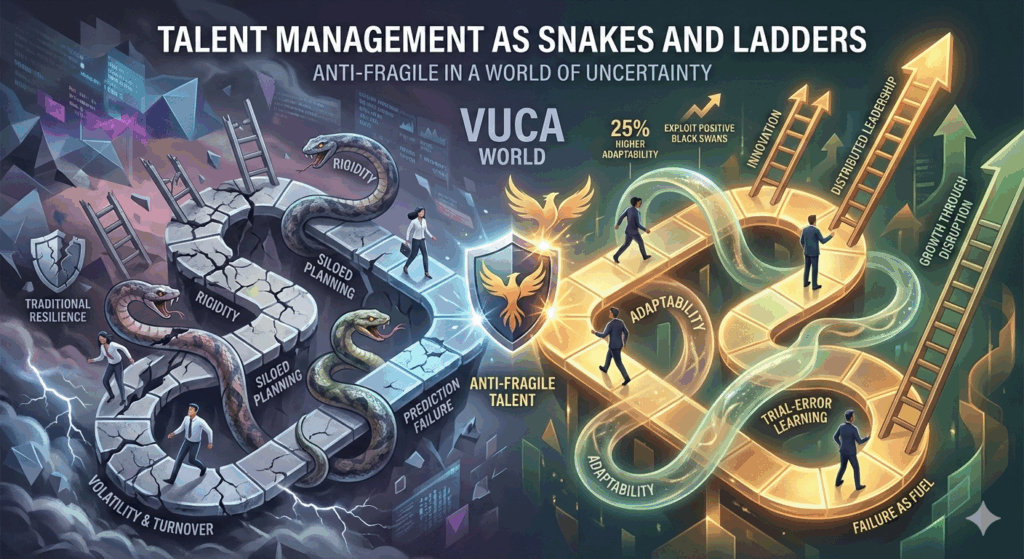
This is where the game comes in. Talent management is fundamentally a game of Snakes and Ladders:
- Ladders: Represent structured, accelerating opportunities—rapid promotions, cross-functional projects, deep mentorships.
- Snakes: Represent the inevitable setbacks arising from calculated risks—failed projects, market downturns, or even organizational restructures.
A fragile system seeks to eliminate the snakes, but by doing so, it also limits the ladders. An anti-fragile system ensures the ladders are robust and frequent, while the snakes, though present, lead to valuable learning, not irrecoverable disaster.
3. The Anti-Fragile Mandate
To transition from fragility to anti-fragility, we must fundamentally rethink our organizational DNA:
- Accept Prediction Limits: Stop basing strategy on perfect forecasts.
- Embrace Evolutionary Change: Move from top-down design to continuous trial-and-error.
- View Failure as Innovation Fuel: Systematically extract lessons and iterate, rather than punishing missteps.
- Align Leadership Rewards to Consequences: Leaders should benefit from upside potential but also bear consequences for reckless fragility, encouraging smarter risk-taking.
Alternative Perspectives and Solutions
While the shift to anti-fragility is critical, it presents several implementation challenges that require nuanced solutions:
| Challenge | Fragile Approach (Control) | Anti-Fragile Solution (Experimentation) |
| Succession | Filling pre-defined boxes (Organogram). | Distributed Leadership: Identifying and empowering multiple “heirs” for every critical role, allowing for organic competition and emergence. |
| Risk Tolerance | Punishing failure; rewarding safe, predictable delivery. | “Small Bets” Investment: Allocating dedicated budgets for high-risk, high-reward projects with rapid feedback loops. Failure is cheap, fast, and informative. |
| Process | Centralized, bureaucratic controls and rigid performance cycles. | Process Simplification & Minimalist Rules: Adopting simple, non-negotiable rules that govern intent, allowing maximum local autonomy for execution (the “minimum viable bureaucracy”). |
This bottom-up approach to anti-fragile talent strategies is proven. A 2023 McKinsey study highlighted that anti-fragile firms demonstrated 25% higher adaptability during economic shocks. Conversely, those stuck in fragile models face significant losses, including up to 20% more employee turnover (as noted by a 2024 Gallup analysis).
Practical Summary and Action Plan
We must heed Taleb’s call: exploit positive black swans by de-risking the negatives. The investment required to manage talent must yield robust strength, not hidden vulnerability.
My Anti-Fragile Talent Action Plan:
- Stop Planning, Start Probing: Eliminate the annual, rigid succession plan. Replace it with quarterly talent probes—rapid, scenario-based discussions focused on “What if X failed?” rather than “Who is ready for Y?”
- Decentralize Risk and Reward: Implement a system where project managers and divisional leaders have greater budget authority but are personally accountable for the learning outcomes of both successes and failures.
- Build a Talent Innovation Lab (TIL): Create a low-consequence internal environment where employees are deliberately rotated into novel, high-uncertainty projects for 90 days. Their goal is not success but generating three critical lessons.
- Simplify and Distribute Technology: Move away from monolithic HR systems. Deploy flexible, modular technology (e.g., skills databases, internal gig platforms) that allows business units to quickly deploy and experiment with new team structures without central HR approval.
The mandate for talent teams is clear: evolve from controllers to experimentation architects. By doing so, we transform uncertainty from a threat into our single greatest source of competitive advantage, building innovative organizations robust enough for truly turbulent times.