
Ethical Ambition: How to Climb the Ladder Without Losing Your Soul
Ambition is often painted in binary colors. We are told we must choose between the ruthless, hyper-competitive drive to reach the summit, or a quiet, compromised retreat into comfort to keep our values intact. This is a false dichotomy.
True leadership does not demand that you check your soul at the door of the C-suite. In fact, long-term organizational impact requires the exact opposite. When ambition is untethered from an inner foundation, its realization feels hollow—a classic trap of status-seeking that leaves leaders burning out at the peak of their careers.
To scale your impact without losing your essence, you must cultivate Ethical Ambition. This is the conscious practice of aligning your vertical growth with your horizontal expansion—ensuring that as your power and reach increase, your self-awareness, relational depth, and structural integrity deepen alongside them.
Here is an architectural blueprint for navigating value-aligned growth in a complex corporate landscape.

1. The Core Direct Response: Redefining Ambition
Ethical ambition is not the absence of drive; it is drive with resonance. It transitions a leader from asking “How do I conquer this ecosystem?” to “How do I elevate this ecosystem while scaling my capabilities?” Climbing the ladder without losing your soul requires shifting your focus from outward validation (status, titles, and pure metrics) to inward wholeness. When your core is grounded, your upward mobility becomes an asset to your organization rather than a hazard to your well-being.
2. Step-by-Step Explanation: The Framework for Value-Aligned Growth
Achieving this alignment requires a deliberate, systematic approach. We can break this down into four foundational shifts, moving from the internal landscape to systemic execution.
Step 1: Establish Your Inner Anchor (Being)
Before you can lead others ethically, you must master self-leadership. This begins by auditing your core drivers. Are you running toward a vision, or are you running away from a fear of insignificance?
- The Practice: Define your non-negotiables. These are the core values that cannot be traded for a promotion, a bonus, or political favor. When a decision challenges these boundaries, your inner anchor provides the friction necessary to pause and re-evaluate.
Step 2: Navigate with Relational Resonance (Relation)
As you ascend, the temptation to view people as chess pieces increases. Ethical ambition views relationships as the primary fabric of leadership, not as transactional leverage.
- The Practice: Shift from transactional networking to systemic connection. Build alliances based on mutual growth and psychological safety. When you protect and elevate your peers and direct reports, you create a sustainable support structure that naturally lifts you higher.
Step 3: Architect Ethical Frameworks (Structure)
Values that live only in your head are useless under corporate pressure. You must institutionalize your ethics into your daily operating procedures.
- The Practice: Create objective filters for your decision-making. When faced with a crossroad—such as a high-revenue project that compromises team well-being versus a lower-yield, sustainable alternative—use a structured matrix that evaluates long-term systemic health alongside short-term ROI.
Step 4: Scale Responsibly (Scaling)
True scaling is about expanding your positive impact, not just your territory. As your scope grows, your responsibility to model transparent, high-integrity behavior multiplies.
- The Practice: Ensure that your systemic footprint leaves the organization healthier. This means actively mentoring the next generation of leaders, fostering cultural intelligence across borders, and ensuring that your team’s achievements are shared collectively.
3. Alternative Perspectives & Complex Realities
While alignment sounds ideal on paper, the corporate ecosystem often introduces friction. Let’s look at two common counter-arguments or systemic traps:
- The “Nice Guys Finish Last” Myth: A common perspective is that high integrity creates vulnerability in highly competitive environments. The counter-solution here is not to become passive, but to practice fierce integrity. Ethical ambition is not soft; it requires deep courage to speak truth to power, hold people accountable, and draw firm boundaries. High standards and deep empathy must coexist.
- The Golden Cage Trap: Often, leaders believe they can compromise “just this once” to get to the next level, planning to fix things once they have the authority. This is a slippery slope. The choices you make on the way upform the muscle memory of how you will lead at the top. You cannot build a temple of integrity using bricks of compromise.
4. Action Plan for Immediate Application
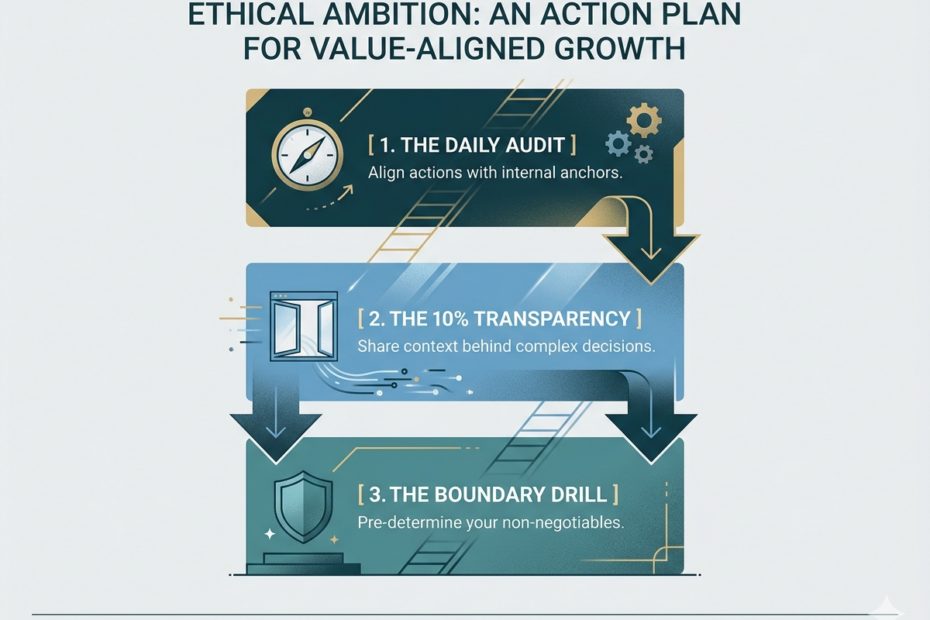
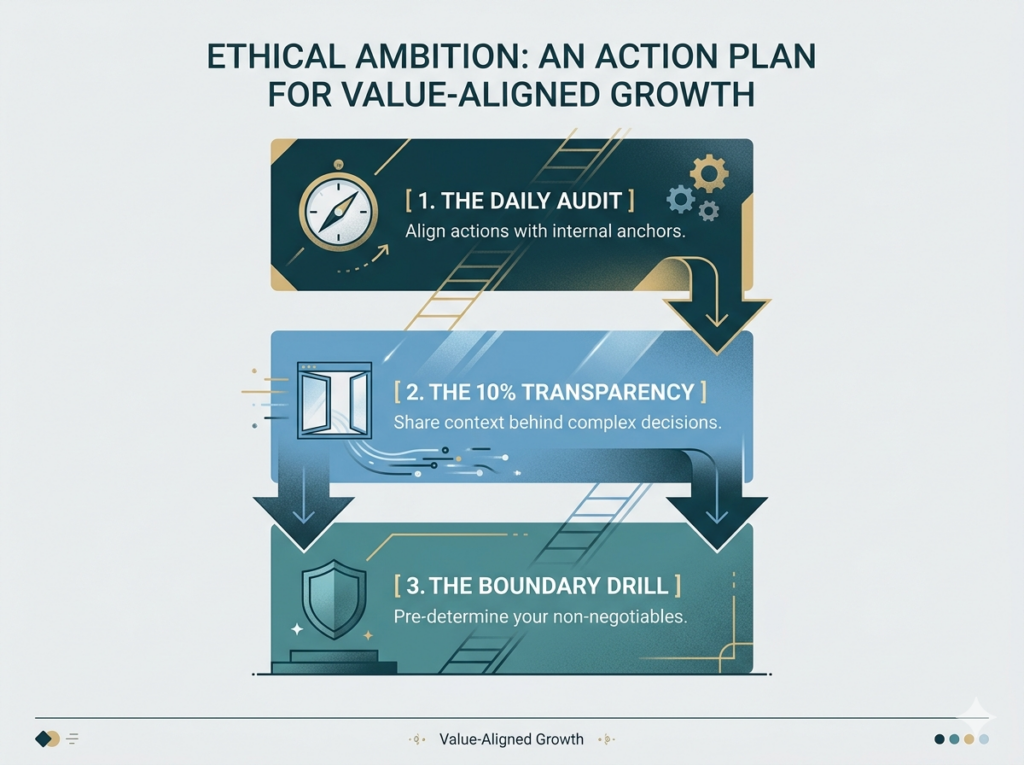
To translate ethical ambition from a concept into a daily practice, implement the following steps:
- The Daily Audit: At the end of each day, ask yourself: Did my actions today reflect the leader I want to be remembered as? If there is a gap between your behavior and your values, trace it back to the pressure point that caused it.
- The 10% Transparency Rule: In your next cross-functional or executive meeting, practice sharing the ethical context behind a business decision. Instead of just presenting the metrics, articulate how the chosen path protects the team’s integrity and long-term trust.
- The Boundary Drill: Write down three specific scenarios where corporate pressure might ask you to compromise (e.g., overriding a team member’s boundary, spinning data for a presentation, or ignoring a cultural blind spot). Pre-determine your response strategy today, so you are not negotiating with your values in the heat of the moment.
True personal excellence is not about how fast you climb, but how much of yourself you bring with you to the top. By anchored leadership, you don’t just reach the summit—you earn the right to stay there.