
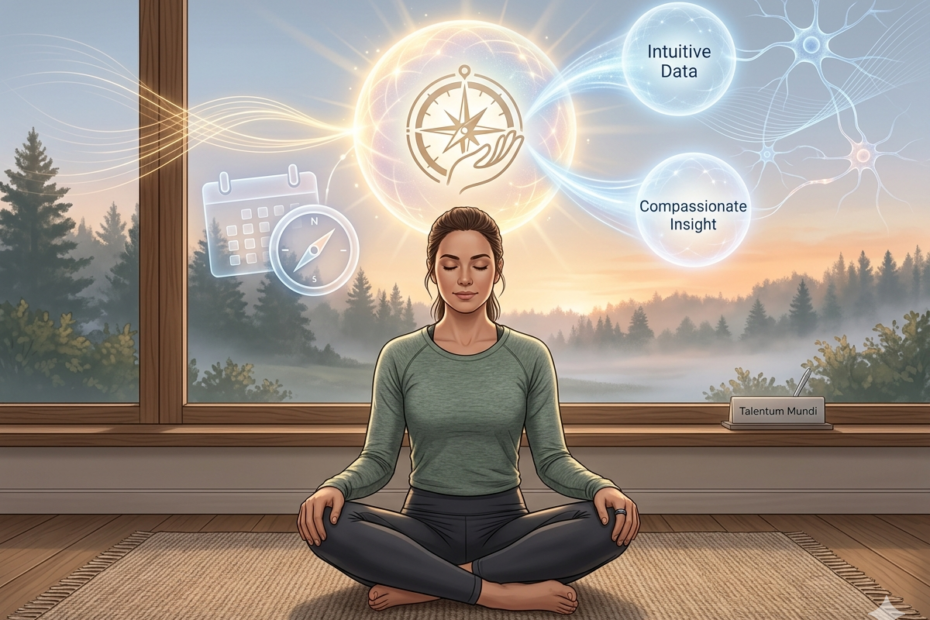
Whether we are optimizing performance, health, or leadership, self-reflection is the primary engine of the Plena™ Model.
Even in an era of constant digital broadcasting, true self-awareness remains a rare commodity. While 95% of people believe they are self-aware, research shows only about 12% actually are. At Talentum Mundi, we recognize that this “awareness gap” is the single greatest barrier to sustainable growth.
Within the Plena™ Model, self-awareness isn’t just a soft skill—it is a functional requirement. It is the bridge between knowing what to do and actually doing it.
Beyond the Surface: What Real Awareness Looks Like
In the Plena™ Model, we distinguish between productive self-reflection and the “noise” of modern self-focus. Self-awareness is not:
- Rumination: Replaying failures in a loop of distress.
- Narcissism: A preoccupation with self-image over self-insight.
Instead, self-awareness is the capacity to non-judgmentally observe your internal state. It asks: What is happening for me right now? What am I thinking? What am I feeling? This curious, objective examination is what predicts personal growth and resilience.
Self-Awareness as a Superpower for Habits
When we attempt to change behavior through sheer willpower, we often fail. The Plena Model shifts the focus from “trying harder” to “seeing clearer” through three strategic pillars:
- Interrupting the Autopilot: Two-thirds of our daily behaviors—mindless snacking, reactive communication, or digital distractions—happen on autopilot. Self-monitoring brings these into conscious view. You cannot transform a pattern you cannot see.
- Bridging the Value-Action Gap: Awareness makes us conscious of the distance between our current state and our “Plena” (full/complete) potential. This creates intrinsic motivation, which is far more durable than external pressure.
- Rewiring the Reward System: When awareness aligns your actions with your core values, the brain encodes those behaviors as more rewarding. Habits stop being a chore and start being a source of fulfillment.
5 Practices to Cultivate Plena™ Awareness
To integrate this into your life and Talentum Mundi journey, apply these evidence-based strategies:
- 1. Measure What Matters: Use objective data—whether it’s time-tracking, health wearables, or food logs. Like a GPS for the soul, data removes the ability to “conveniently forget” truths that hinder your progress.
- 2. Adopt Self-Compassion: High-performance coaching reveals that self-compassion is the best predictor of stress management. Approaching your blind spots with kindness rather than judgment lowers the psychological threat, making hard truths bearable enough to learn from.
- 3. Ask “What,” Not “Why”: “Why” questions often lead to justifications and stories. “What” questions keep you curious and forward-facing.
- Instead of “Why am I failing?” ask “What is getting in the way, and what would make it easier?”
- 4. Leverage External Mirrors: We all have blind spots. Seeking feedback from a Talentum Mundi coach or a trusted peer provides an interpersonal path to self-knowledge that introspection alone cannot reach.
- 5. The Power of “Non-Doing”: Practice brief periods of quiet observation (meditation). Training the brain to notice thoughts without reacting to them builds the “awareness muscle” needed for real-time habit correction.
Practical Action Plan
| Step | Action | Objective |
|---|---|---|
| Audit | Select one habit you want to change and track it objectively for 7 days. | Reveal the “Autopilot” patterns. |
| Reframing | Replace “Why” questions with “What” questions during your daily review. | Shift from rumination to solution-seeking. |
| Feedback | Schedule a session with your coach to discuss your perceived blind spots. | Align your self-image with reality. |
Export to Sheets
Self-awareness is not a detour from your best life; it is the fastest route to it. By embracing the Plena™ Model’s emphasis on conscious reflection, you transform habit-building from a struggle of will into a journey of discovery.