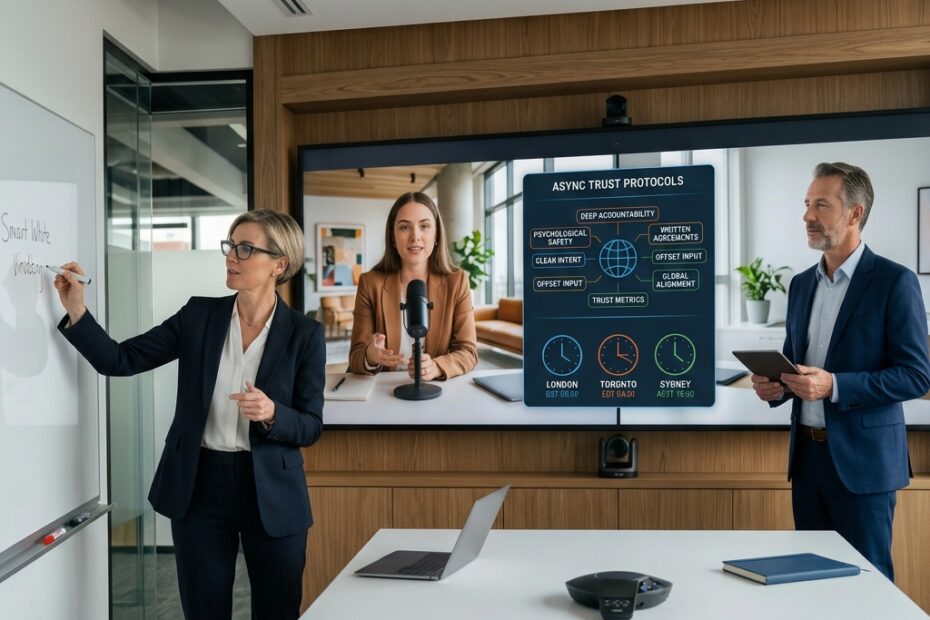

The modern enterprise runs on time zone drift. Executive teams are no longer anchored to a shared floor in a single building; they operate across London, New York, Tokyo, and Athens. Yet, as leadership teams scale across borders, many inadvertently carry over an outdated operational model: the requirement of real-time presence to validate commitment.
When your leadership cadence relies on synchronous touchpoints to generate alignment, trust becomes fragile. It relies on sight lines, quick verbal check-ins, and immediate responses. True organizational resilience requires moving from real-time oversight to Asynchronous Trust—a systemic architecture where deep accountability and psychological safety thrive without requiring everyone to be online at the same time.
The Core Premise: Presence Is Not Performance
The fundamental friction in distributed leadership is confusing immediate availability with reliability. In synchronous-heavy environments, trust is often built on visibility: I see you in the meeting; therefore, I know you are working.
When time zones prevent constant overlap, trying to maintain this dynamic leads to schedule fatigue, context switching, and high-stress micro-management. Asynchronous trust shifts the operational paradigm:
- Synchronous Trust asks: “Are you available right now?”
- Asynchronous Trust asks: “Are our intent, ownership, and agreements so clear that you are empowered to act autonomously while I sleep?”
Building this requires two foundational pillars working in tandem: High Accountability (clarity of ownership and metrics) and Psychological Safety (the freedom to expose risk, admit mistakes, and raise early warnings without fear of penalty).

Key Components of Asynchronous Trust
1. Explicit Intent Over Implicit Expectation
In real-time environments, teams rely on context and informal body language to gauge intent. In an asynchronous framework, implicit context disappears.
To build safety, leaders must transition to absolute clarity of intent. This means framing handoffs, strategic memos, and requests with explicit constraints:
- Context: Why is this initiative taking priority now?
- Outcome: What does “done” look like in concrete terms?
- Decision Rights: Who holds final accountability, and what decisions require consultation?
- Response Windows: What is the explicit deadline for feedback? (e.g., “Non-urgent: Review within 48 hours” vs. “Critical blocker”).
When team members understand the boundaries of their authority and the timeline for input, anxiety drops and momentum increases.
2. Radical Transparency via Written Documentation
Psychological safety disintegrates when information becomes asymmetrical. When strategic decisions happen in unrecorded, real-time sidebar conversations, team members in distant time zones wake up to shifting priorities they had no hand in shaping.
Asynchronous trust demands a writing-first culture:
- Strategy Memos over Status Meetings: Complex choices are framed in written documents that outline options, trade-offs, and rationale, allowing leaders across time zones to process and comment thoughtfully.
- Public Repositories: Project decisions, risk assessments, and OKRs live in centralized, accessible spaces—not buried in private chat threads or direct messages.
- Asynchronous Debate: Critical decisions are exposed to structured comment cycles before final execution, giving introverted or offset-time-zone executives equal voice.
3. Psychological Safety as a Systems Design Choice
Psychological safety in an asynchronous setting is not built through casual coffee chats; it is built through predictable, safe communication loops.
When a distributed leader makes a mistake or encounters a blocker, the distance can magnify fear. If the culture rewards immediate, defensive answers, leaders will stay silent until a problem becomes a crisis.
- Early-Warning Reward Systems: Establish a clear protocol for flagging risks early in written updates. Reward the prompt disclosure of bad news rather than penalizing the issue itself.
- Asynchronous Retrospectives: Use collaborative boards for regular, transparent reviews of completed milestones. Focus on system breakdowns rather than individual fault.
- Decoupled Escalation Pathways: Define precise criteria for what constitutes a true synchronous emergency (requiring phone calls across time zones) versus an asynchronous blocker (logged for the next business day).
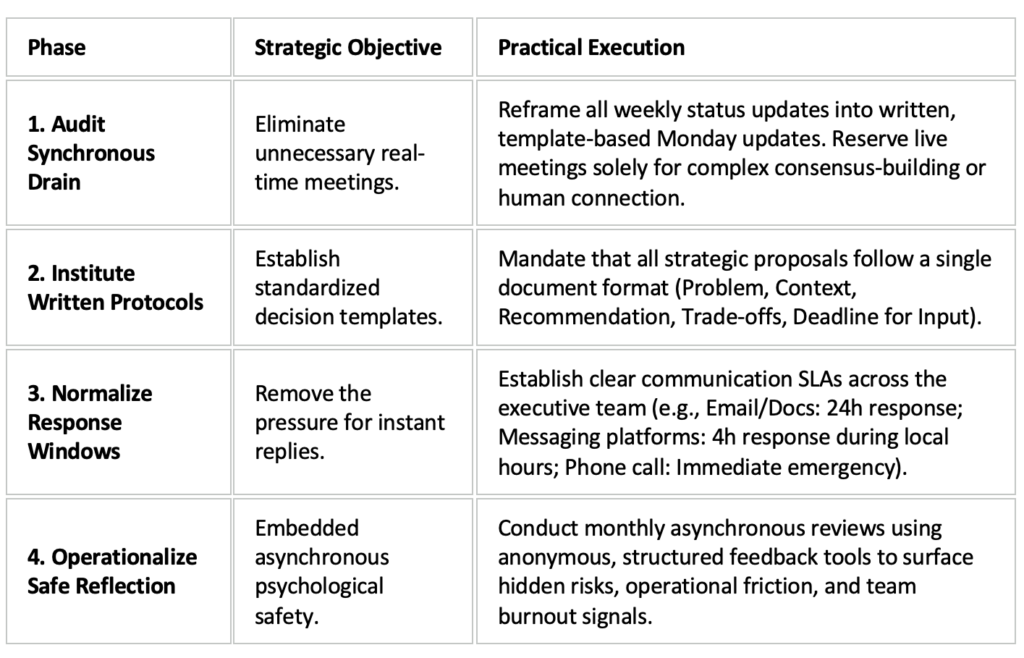
A Four-Step Action Plan for Distributed Executive Leadership
To move your leadership team from real-time dependence to asynchronous maturity, implement this operational sequence:
Sustainable Leadership Across Distance
Asynchronous trust is not merely a remote-work concession; it is a higher form of organizational design. It forces leadership teams to move away from reactive management toward intentional, well-considered, and transparent decision-making.
By anchoring your team in clear documentation, explicit intent, and psychological safety, distance ceases to be a operational barrier. It becomes your strategic advantage.