The Core Crisis: Why Our Talent Systems Are Failing the Human Element
I’ve been watching the so-called “war for talent” for years, and what I’ve realized is that the battle isn’t being won on the spreadsheets or in the latest HR software; it’s being lost in the hallways and in the awkward, often nonexistent, conversations between managers and their employees. The initial insight about the current state of talent management is spot-on—it’s a muddle, a series of rituals that feel heavy, complex, and utterly disconnected from the real work and the real people driving it.
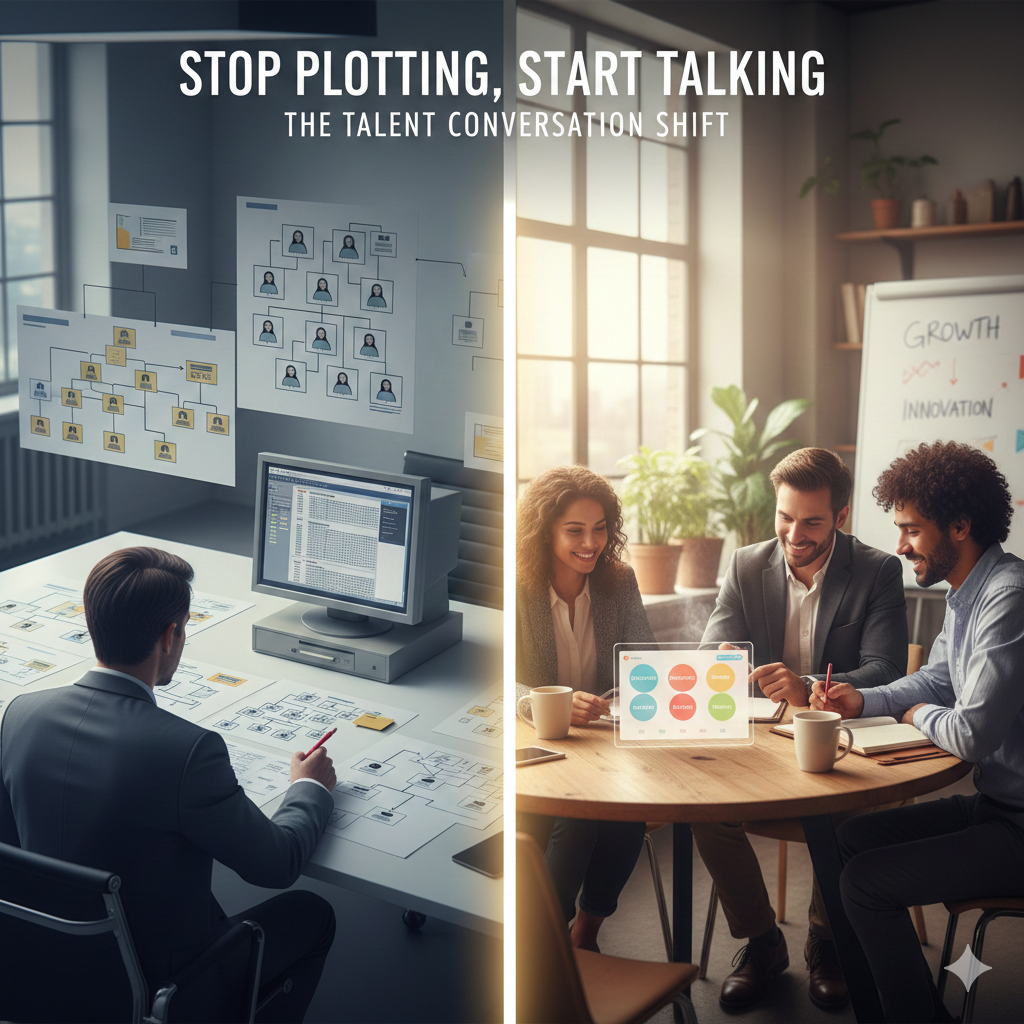
We spend enormous amounts of energy on things that just don’t move the needle. Organizations are relentlessly trying to connect broad business challenges to granular talent reviews, but the link is usually tenuous at best. We dedicate weeks to meticulously mapping employees onto the infamous 9-Grid plot—that matrix of performance versus potential—only to then stare blankly at the results. How do you translate a dot in a box into actionable, targeted retention strategies? How do you use that plot to differentiate performance for targeted investments? More often than not, it becomes a yearly intellectual exercise that yields no substantive change in development or career trajectory.
And the biggest tragedy of this top-down approach? It completely fails to engage line managers in the necessary follow-through. They view talent management as an HR mandate, a check-the-box activity that takes them away from their actual job. They dread the review meetings because the framework is complex, the language is corporate jargon, and they feel ill-equipped to facilitate the kind of authentic dialogue that genuinely links organizational priorities to individual career growth. As the observation from Lisa Haneberg highlights, our current metrics are obsessed with measuring the efficiency and output of the HR function itself—how many forms were filed, how many meetings were held—but they utterly overlook the fundamental, human reasons why employees choose to stay, to grow, or, tragically, to stagnateand eventually leave. The complexity we’ve introduced—the convoluted frameworks, the excessive number of assessment tools, the clunky technology—doesn’t facilitate progress; it bogs us down. It turns talent management from a dynamic, strategic dialogue into a series of siloed, annual rituals.

The Pivotal Shift: From Top-Down Plotting to Bottom-Up Dialogue
The only way out of this “muddle” is a complete, fundamental rethinking of success dynamics within talent management. We need to stop seeing our people as data points to be manipulated and start seeing them as agents of their own careers. This requires a profound shift from top-down plotting to bottom-up conversations.
The current process is built on a flawed premise: that HR and senior leadership, isolated in a conference room, can accurately judge, label, and plan the future of every employee. This breeds resentment, disengagement, and inaccuracy. The power of the individual voice is lost.
Instead, we need to empower the employees and their immediate managers to drive the process. How do we do this? By making the process simpler, more frequent, and more human. I envision deploying simple, intuitive online tools that aren’t about inputting scores for a grid, but about asking the right questions of the right people at the right time.
Imagine a system that focuses on fostering self-reflection first, asking the employee: What truly energizes you? What skills do you want to master in the next 18 months? What barriers are currently preventing your success? Then, it opens up a dialogue, pulling in perspectives from the manager and a handful of selected peers. This isn’t a complex, 360-degree assessment; it’s a focused, forward-looking conversation.
This approach organically builds genuine talent intelligence. It’s not about judging someone’s ambiguous “potential;” it’s about understanding their tangible aspirations, documented strengths, and specific barriers to progression. For example, instead of a sterile debate among leaders about whether ‘Sarah’ is a “High Potential,” the system facilitates an open discussion: “Sarah wants to lead a cross-functional project in the next quarter to gain exposure to the Asia market, but she feels she lacks sponsorship. How can we, the management team, address this specific barrier to accelerate her progression and engagement?”
This transformation places career development—the employee’s growth journey—at the absolute center, superseding the reliance on rigid, often arbitrary, performance-potential grids.
The Undeniable ROI: Retention, Innovation, and Agility
This isn’t just a “nicer” way of doing business; it is a demonstrable strategy for resilience and growth. The benefits of a conversation-led talent strategy are not theoretical—they are backed by hard data. The 2023 Deloitte study, for instance, offered a stark, powerful realization: companies that successfully implement conversation-led talent strategies see a significant 25% boost in employee retention and an 18% increase in innovation.
Why? Because in today’s VUCA (Volatile, Uncertain, Complex, and Ambiguous) business environment, talent management needs to be about agility, not bureaucracy. Rigid annual reviews are too slow for a world that changes quarterly. A dynamic, conversation-driven approach allows the organization to constantly:
- Uncover Hidden Talent: The employees on the front lines, often overlooked by leadership, reveal their capabilities and aspirations when given a voice.
- Align Personal Goals with Business Needs: When a manager understands an employee’s passion for data analytics, they can quickly pivot and assign them to a critical, data-intensive project that directly serves a strategic goal. It’s a win-win.
- Mitigate Risks Like Turnover: Continuous, honest dialogue is the best early warning system for disengagement. A simple check-in can uncover an issue with a project or a manager long before it escalates into a resignation letter.
Without this commitment to human-centered dialogue, we perpetuate the fundamental disconnect. Our expensive, detailed assessments muddle into inaction, yielding pages of data that no one knows how to apply. We must, as the original insight implores, move beyond the hype of HR technology—which is merely an enabler—and focus on the human-centered talk that actually drives change.
The Catalyst for Sustainable Growth
This requires us to embed robust, continuous feedback loops into the fabric of the organization. These loops must be two-way streets that empower individuals and managers alike.
The employee is empowered because they own their narrative and drive the conversation. The manager is empowered because the process is simple, focused, and directly ties the conversation to team output and business strategy. They stop being administrators of an HR process and start being coaches and architects of talent development.
This transformation is the difference between talent management being a “muddle”—a confusing, laborious administrative task—and it becoming a catalyst for sustainable growth. In competitive, rapidly changing markets, we cannot afford to treat careers as an afterthought, something that happens after the performance rating is given. Instead, career progression, development, and aspiration must be core to our business strategy.
By prioritizing the human dialogue, we ensure that our people are not just assets to be deployed, but partners whose growth is intrinsically tied to the success of the entire organization. We move beyond the 9-grid and into the actual, messy, and meaningful business of human development. That, to me, is the only way forward.
Does this perspective on shifting to human-centered career conversations resonate with your own experiences in the workplace? I’d be interested to know which aspect of this transition you feel is the biggest hurdle for organizations today.