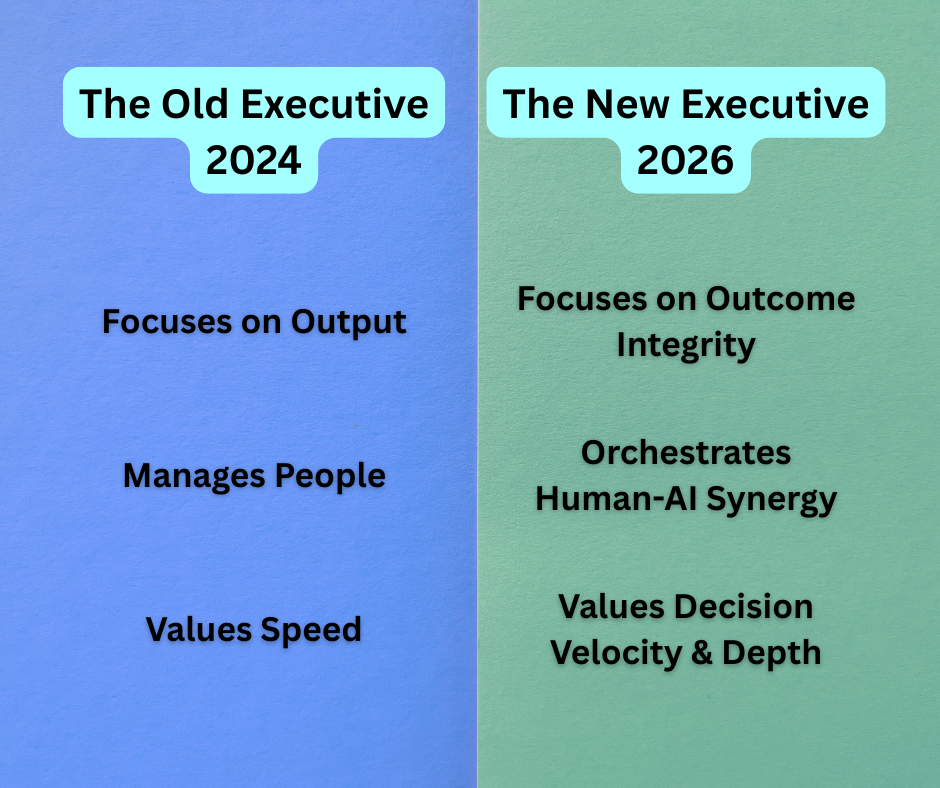
In 2024, we asked if AI would replace the worker. In 2025, we asked if it would replace the manager. By 2026, the verdict is in: AI hasn’t replaced the leader, but it has irrevocably changed the nature of the work. For the modern executive, the challenge is no longer how to do the job, but who they must be to govern an ecosystem of human and artificial intelligence.
Executive coaching has evolved to meet this moment, moving from a “remedial” or “performance-boosting” tool to a critical pillar of Strategic Governance and Psychological Sovereignty.

1. The 2026 Reality: Decision Velocity and the “Insight Gap”
The primary struggle for today’s executive isn’t a lack of data—it’s the overwhelming abundance of it. With Agentic AI systems now managing 60% of operational decision-making, the executive’s role has shifted to “The Final Arbiter.”
- The Problem: High search volume for “Decision Fatigue” and “Leadership Isolation” confirms that while machines provide the what, they cannot provide the why.
- The Coaching Shift: At the MCC level, we focus on Decision Velocity. We aren’t coaching you to make the right choice; we are coaching you to build the internal “meta-framework” that allows you to make high-stakes decisions with 40% less “perfect” information than your predecessors.
2. From Emotional Intelligence to “Parallel Intelligence”
The trending energy on platforms like Instagram and LinkedIn suggests a move toward “Soft Productivity.” For an executive, this translates to Parallel Intelligence: the ability to balance machine-driven efficiency with deep, messy, human intuition.
- The Rise of the “Human Friction” Specialist: We are seeing a premium on “Discernment.” A coach’s role in 2026 is to help you identify when to overrule the algorithm.
- The Goal: To move from being a “Technical Expert” to an “Ecosystem Orchestrator.” You aren’t just leading people; you are leading a hybrid workforce of freelancers, full-time staff, and AI agents.
3. The Three Pillars of 2026 Executive Coaching
I. Cognitive Adaptability (The “Change Fitness”)
In a world where market shifts happen in weeks, not quarters, “Change Management” is too slow. Coaching now focuses on Change Fitness—the biological and psychological ability to reset your baseline without burnout.
“The executive of 2026 doesn’t manage change; they embody it.”
II. Ethical Governance & Purpose Alignment
As AI handles the “how,” the “why” becomes the only true differentiator. Predictive search data shows a spike in “Values-Based Leadership.” Coaching sessions are increasingly becoming the only “safe space” where an executive can interrogate the ethical implications of their tech-stack without corporate filter.
III. Psychological Sovereignty
Isolation is the silent killer of the C-suite. With the democratization of coaching (AI bots for middle managers), the human executive coach is now a luxury of Presence. The coaching relationship in 2026 is about reclaiming your “sovereignty”—ensuring your identity is not defined by the speed of your Slack notifications, but by the depth of your vision.