Have you ever been absolutely confident in a skill, only to receive feedback that revealed a significant gap between your self-perception and reality?
For most people, this kind of reckoning is uncomfortable. But as an executive coach, I can tell you that this moment of friction is actually one of the most valuable experiences a professional can have. It is the exact point where true, transformative development begins.
The Blind Spot Phenomenon
In leadership and professional development, there is a recurring and striking theme: the gap between how people see themselves and how others actually experience them. This is often driven by the Dunning-Kruger effect, a psychological phenomenon where confidence outpaces competence.
Essentially, the lack of awareness that leads to subpar performance also impairs a person’s ability to accurately assess that performance. Those who struggle often overestimate their abilities, while high-performing individuals tend to underestimate their skill, recognizing the sheer complexity of their work.
While much has been written about this regarding executives, a massive study by Zenger Folkman looked at over 15,000 individual contributors to see how this manifests on the ground. They identified a significant group of professionals who rated themselves in the top quartile of performance, while their direct managers rated them in the bottom quartile.
This isn’t a minor disagreement; it represents a fundamental misalignment in self-perception versus observable reality.
The 8 Behaviors You Are Most Likely to Overrate
To bridge this gap, we must look at the specific behaviors where professionals commonly misjudge themselves. This acts as an early warning system to help you calibrate more honestly.
- Role Modeling & Influence: Your work ethic, attitude, and habits send powerful signals. When a colleague cuts corners, it signals that lower standards are acceptable. Conversely, consistent effort elevates everyone. Ask yourself: What message is my behavior sending today?
- Building and Sustaining Trust: Trust is built through radical consistency—doing what you say you will do, every single time. Small lapses quietly erode credibility.
- Anticipating and Preventing Problems: It is rarely the massive risks that derail projects; it is the small, overlooked details. Developing a habit of “pre-flight thinking”—pausing to anticipate friction before submission—separates good performers from exceptional ones.
- Follow-Through and Personal Organization: This is where the gap between self-perception and manager reality is widest. Your memory is not a reliable system. If you make a commitment, capture it mechanically.
- Drive and Work Ethic: There is a vast difference between doing a job and doing it exceptionally. The professionals who stand out consistently push beyond the baseline requirement, delivering higher quality than expected.
- Speaking Up and Offering Feedback: Many default to silence to avoid looking critical, but surfacing a problem before it escalates builds a reputation as someone who cares about outcomes over personal comfort.
- Walking the Talk: Credibility is killed by inconsistency. Aligning what you advocate for with what you actually practice earns a rare kind of respect.
- Communicating with Clarity: An idea that is crystal clear in your mind can easily become muddled in delivery. Effective communicators do not rely on natural ability; they structure their messages and practice out loud.
Step-by-Step Analytical Breakdown
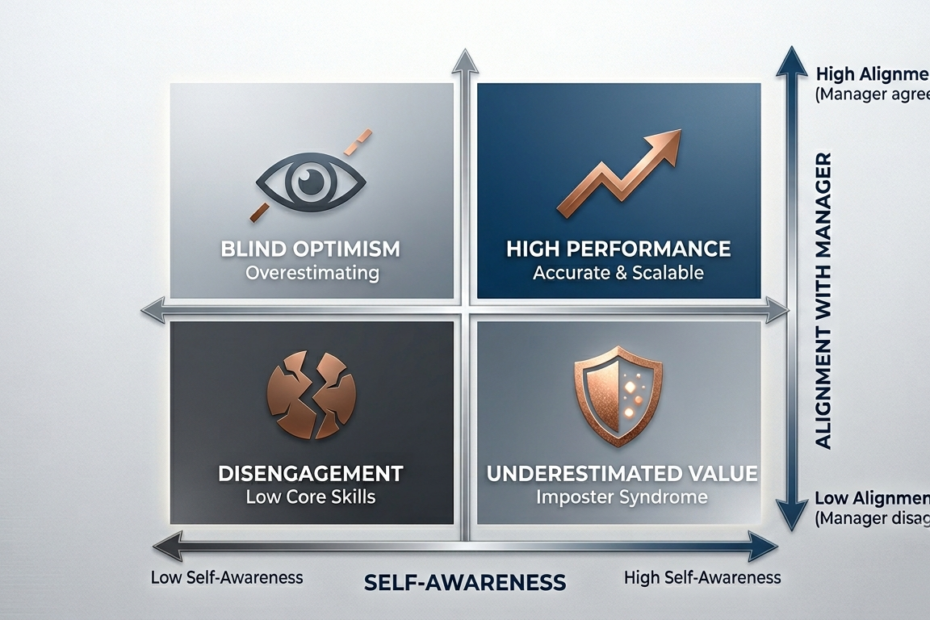
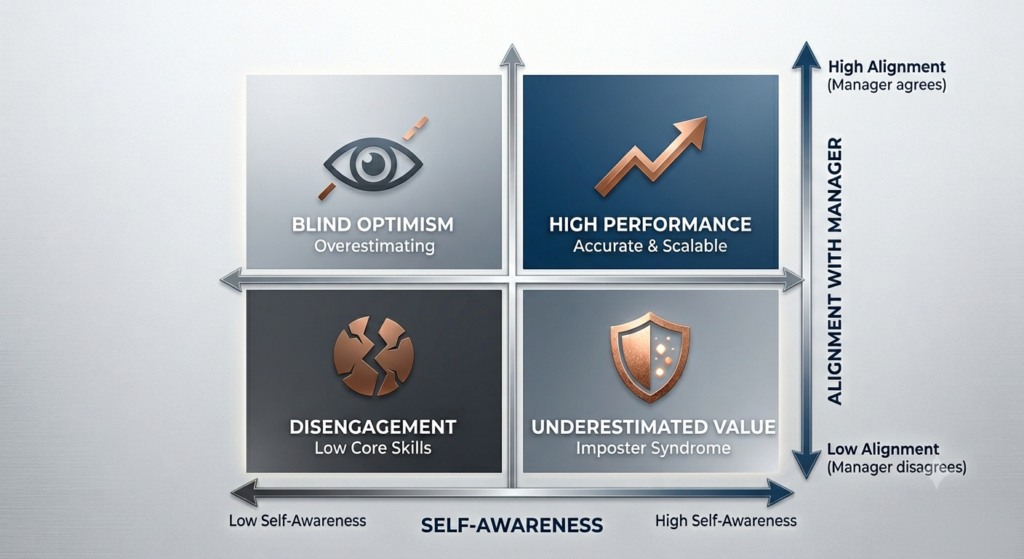
To understand how this feedback gap occurs and how to systematically diagnose it, we look at the interaction between two primary axes: Self-Awareness and Manager Alignment.
- Data Isolation: The discrepancy occurs because individual contributors rate themselves based on intentions, whereas managers rate them strictly on observable behaviors and outcomes.
- Behavioral Friction: The largest gaps manifest in high-visibility, relational execution behaviors (like communication and follow-through) rather than isolated technical skills.
- Root Cause Analysis: The cognitive bias stems from a lack of active feedback loops. Without explicit external data, the brain defaults to a self-serving bias to maintain psychological comfort.
Alternative Perspectives to Consider
While it is easy to assume that a discrepancy means the employee is simply wrong, an MCC-level coach looks at systemic variables:
- The Psychological Safety Variable: Is the manager creating an environment where the employee feels safe enough to receive constructive feedback without entering a defensive threat state? If feedback is withheld until annual reviews, misalignment is a systemic failure, not just an individual one.
- The Mismatched Criteria Lens: Sometimes, the gap isn’t a lack of skill, but a lack of shared definitions. What the employee defines as “clear communication” might differ wildly from the manager’s operational standard. Alignment requires calibrating definitions before calibrating performance.
Action Plan: Closing the Gap
Self-awareness is not a soft skill; it is the foundation of all professional growth. Use these four steps to realign your self-perception with reality:
| Step | Action Item | Operational Checklist |
|---|---|---|
| 1 | Seek Proactive Feedback | Do not wait for a review. Ask your manager specific behavioral questions: “When I present in meetings, what would make my message more impactful?” |
| 2 | Calibrate with Evidence | Before rating yourself highly on a skill, look for concrete, recent data points. What objective evidence proves you excel here? |
| 3 | Externalize Your System | Stop relying on memory. Implement an infallible tracking system for commitments to ensure no deadline slips through. |
| 4 | Audit Your Alignment | Identify one standard you expect from others and ruthlessly audit how consistently you model it yourself. |