
Most leadership challenges are not capability problems.
They’re perspective problems.
A team leader thinks differently than a director. A director thinks differently than an executive. And yet many leaders continue operating at the same altitude long after their responsibilities have expanded.
The most effective leaders learn to intentionally shift perspective, seeing both the immediate terrain and the distant horizon.
Think of leadership as a series of altitudes.
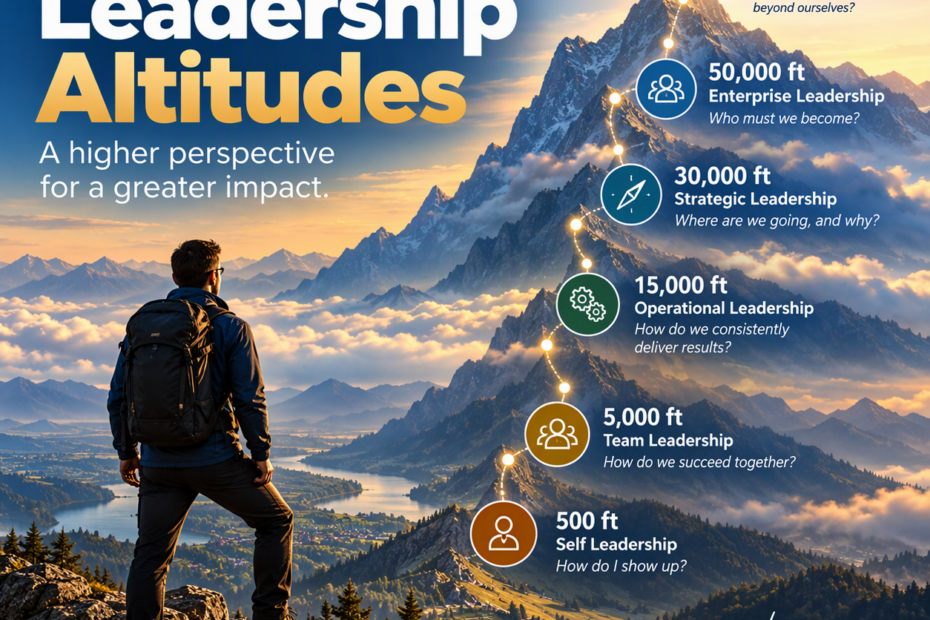
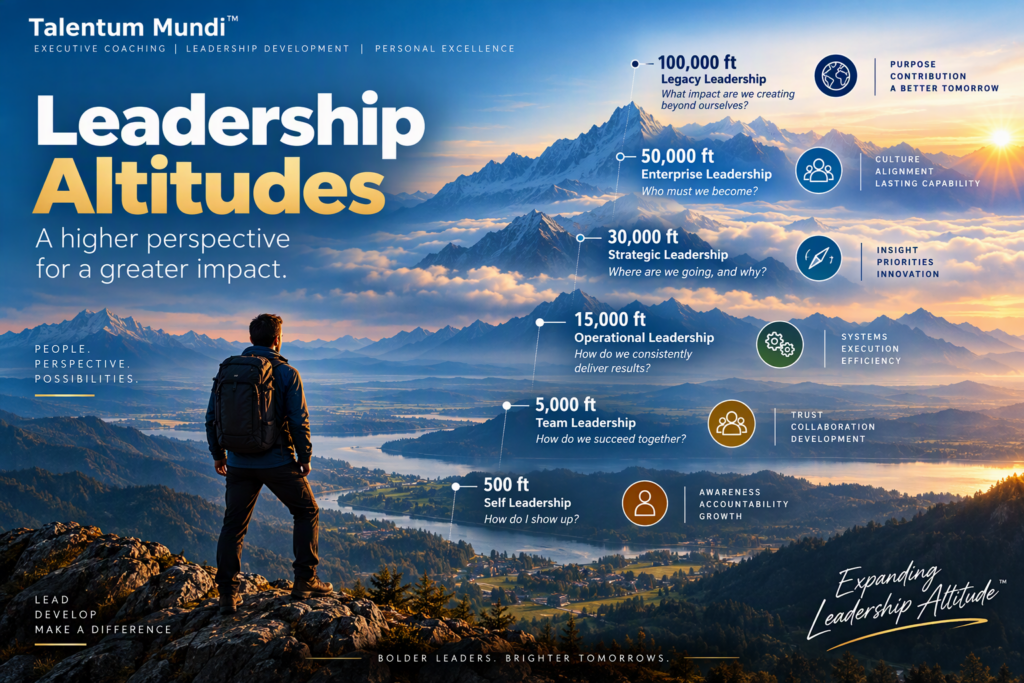
500 Feet: Self Leadership
At this altitude, leadership begins with you.
The focus is on personal effectiveness, emotional intelligence, accountability, and self-awareness.
Key Question:
How do I show up?
Leaders at this level learn to manage their emotions before managing others. They take responsibility rather than blame circumstances and create credibility through consistency.
Typical Role: Individual Contributor, Specialist, New Supervisor
5,000 Feet: Team Leadership
Now the focus shifts from me to we.
Success is no longer about your performance. It’s about the performance of the people around you.
Leaders build trust, coach others, resolve conflict, and create environments where people can succeed together.
Key Question:
How do we succeed together?
Typical Role: Supervisor, Team Leader, Front-Line Manager
15,000 Feet: Operational Leadership
At 15,000 feet, leaders stop managing people one at a time and start managing systems.
Processes, resources, workflows, priorities, and cross-functional collaboration become the primary focus.
Key Question:
How do we consistently deliver results?
The challenge is no longer individual performance, but organizational effectiveness.
Typical Role: Manager, Senior Manager, Functional Leader
30,000 Feet: Strategic Leadership
This is where leadership shifts from execution to direction.
Strategic leaders spend less time solving today’s problems and more time preparing for tomorrow’s opportunities.
They look for trends, challenge assumptions, and make choices about where the organization should invest its energy.
Key Question:
Where are we going, and why?
Typical Role: Director, Senior Director, General Manager
50,000 Feet: Enterprise Leadership
Many leaders can create strategy.
Far fewer can create alignment.
At 50,000 feet, leaders think beyond their function, department, or business unit. Their focus is the health and effectiveness of the entire organization.
Culture, leadership pipelines, stakeholder alignment, and enterprise capability become their responsibility.
Key Question:
Who must we become?
Typical Role: Vice President, Senior Vice President, Executive Leader
100,000 Feet: Legacy Leadership
At the highest altitude, leaders think beyond organizational success.
They focus on contribution, purpose, industry impact, and legacy.
The question is no longer simply whether the organization succeeds, but whether it makes a meaningful difference.
Key Question:
What impact are we creating beyond ourselves?
Typical Role: CEO, Founder, Industry or Community Leader

The Two Transitions That Define Leadership Growth
From 15,000 Feet to 30,000 Feet
The hardest shift for many managers is moving from operations to strategy.
At 15,000 feet your value comes from having answers.
At 30,000 feet your value comes from asking better questions.
The question changes from:
“How do we do this better?”
to
“Is this the right thing to be doing at all?”
From 30,000 Feet to 50,000 Feet
The second major transition is moving from strategy to enterprise leadership.
Strategic leaders focus on plans.
Enterprise leaders focus on culture, alignment, and capability.
The question changes from:
“What should we do?”
to
“Who must we become to achieve it?”
A Simple Leadership Diagnostic
Ask yourself:
What occupies most of my thinking?
- 500 ft: Myself
- 5,000 ft: My team
- 15,000 ft: Processes and execution
- 30,000 ft: Strategy and future direction
- 50,000 ft: Culture and organizational alignment
- 100,000 ft: Legacy and contribution
Your answer reveals your current leadership altitude.
Final Thought
The goal isn’t to stay at the highest altitude.
A CEO occasionally needs to descend into operational details. A manager must sometimes step back and think strategically.
The art of leadership is knowing which altitude the situation requires and moving there consciously.
Because leadership is not measured by how many people report to you.
It is measured by how much horizon you can see.
At Talentum Mundi™, we help leaders expand their altitude, moving from managing tasks to shaping organizations, cultures, and lasting impact.