
In today’s leadership environment — fast, complex, multicultural, and overloaded — executives don’t reward long explanations. They reward clarity, altitude, and decision‑readiness. Two frameworks deliver this consistently: The 3‑Point Executive Frame and the 1‑2‑1 Model.
Although they look similar at first glance, they serve different leadership moments, train different cognitive muscles, and shape different executive signals. Together, they form one of the most powerful communication toolkits available to senior leaders.
Why Executive Frameworks Matter More Than Ever
Executives today operate in environments defined by:
- information overload
- rapid decision cycles
- global teams
- hybrid communication
- constant context switching
In such conditions, leaders who communicate with density, detail, or chronology lose the room. Leaders who communicate with structure, altitude, and momentum win it.
This is where the 3‑Point Executive Frame and 1‑2‑1 Model shine.

The 3‑Point Executive Frame: The Executive Altitude Tool
The 3‑Point Executive Frame is a top‑down communication model designed for senior‑level clarity.
The Structure
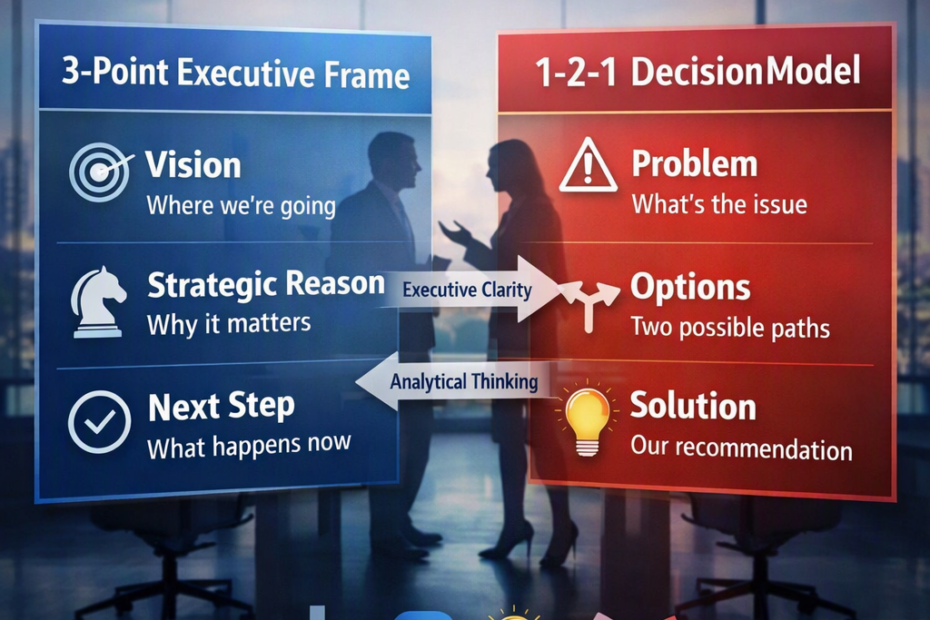
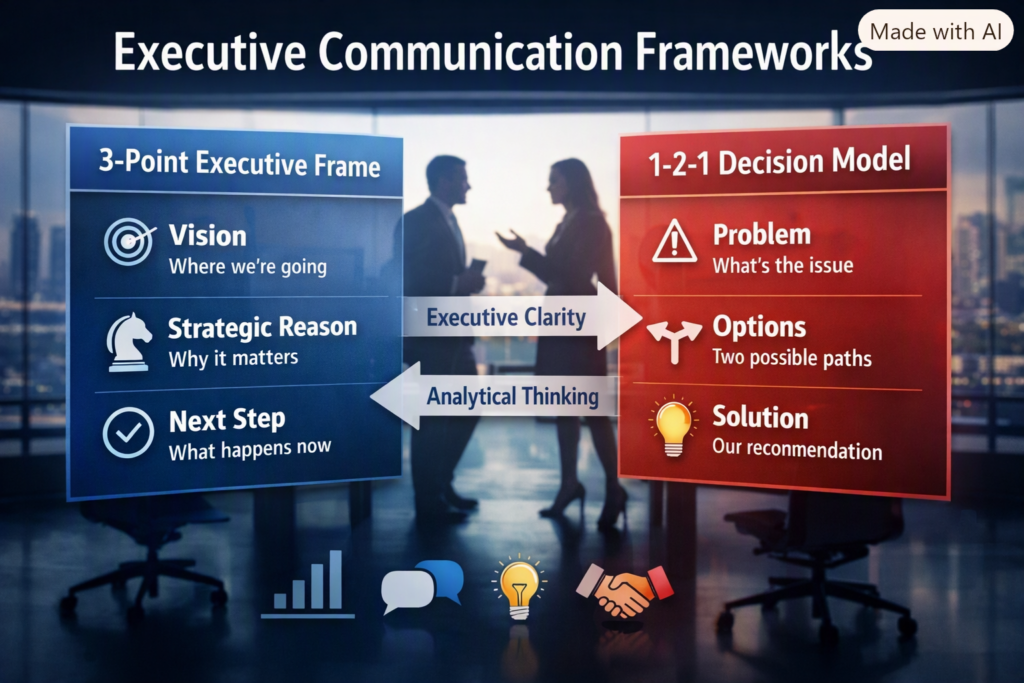
- Vision — What we’re doing
- Strategic Reason — Why it matters
- Next Step — What happens now
This is the communication pattern executives naturally prefer: direction → relevance → action.
It compresses complexity into three cognitively optimal chunks, making it ideal for:
- strategy presentations
- leadership updates
- meeting anchoring
- decision communication
- cross‑functional alignment
Why It Works
The 3‑Point Frame eliminates noise and forces altitude. It signals:
- synthesis
- decisiveness
- strategic clarity
- executive presence
It is not a thinking tool — it is a communication tool.
The 1‑2‑1 Model: The Structured Thinking Tool
The 1‑2‑1 Model is a bottom‑up decision‑making framework used to show clear, analytical thinking under pressure.
The Structure
- 1 Problem — What’s the issue
- 2 Options — What are the viable paths
- 1 Solution — What we recommend
This model is ideal for:
- problem‑solving
- Q&A moments
- pressure situations
- decision preparation
- analytical clarity
Why It Works
The 1‑2‑1 Model demonstrates:
- judgment
- tradeoff awareness
- ownership
- structured thinking
Executives trust leaders who show they can think clearly before they speak clearly.
Top‑Down vs Bottom‑Up: The Core Difference
The two frameworks differ in their starting point, altitude, and leadership signal.
| Dimension | 3‑Point Executive Frame | 1‑2‑1 Model |
| Starting Point | Vision (answer first) | Problem (analysis first) |
| Altitude | High‑level, strategic | Mid‑level, analytical |
| Primary Use | Communicating decisions | Making decisions |
| Leadership Signal | Executive presence | Executive thinking |
| Cognitive Load | Very low | Low–medium |
The 3‑Point Frame leads the room. The 1‑2‑1 Model shows your thinking.
Both are essential — but they serve different leadership identities.
How They Work Together
Senior leaders often use the 1‑2‑1 Model privately to think, and the 3‑Point Executive Frame publicly to communicate.
Example
Internal (1‑2‑1):
- Problem: Onboarding is slow
- Options: Redesign process OR increase training resources
- Solution: Redesign process
External (3‑Point):
- Vision: Shift to competency‑based onboarding
- Strategic Reason: Reduce ramp‑up time by 30%
- Next Step: Pilot with two teams
This is the executive version of structured clarity: think bottom‑up → speak top‑down.
When to Use Each Framework
Use the 3‑Point Executive Frame when you need to:
- communicate strategy
- align teams
- update senior leaders
- anchor meetings
- reduce density
- create momentum
Use the 1‑2‑1 Model when you need to:
- solve a problem
- prepare for Q&A
- handle pressure
- present options
- show analytical clarity
- make a recommendation
Why Leaders Need Both
Modern leadership requires two simultaneous abilities:
1. Executive Altitude
The ability to speak with clarity, direction, and strategic relevance.
2. Executive Thinking
The ability to analyze, compare, and decide under pressure.
The 3‑Point Frame builds the first. The 1‑2‑1 Model builds the second.
Together, they create leaders who are:
- clear
- decisive
- credible
- trusted
- effective
Teaching These Frameworks in Leadership Development
For facilitators, the most effective sequence is:
- Teach 1‑2‑1 first → builds analytical clarity
- Teach 3‑Point next → builds executive altitude
- Run conversion drills → builds synthesis and adaptability
This mirrors how leaders naturally evolve: first they learn to think clearly, then they learn to speak clearly.
A Non‑Obvious Insight: The Hidden Leadership Identity Shift
When leaders adopt these frameworks consistently, something deeper happens:
They stop communicating from detail, chronology, or explanation, and start communicating from direction, impact, and momentum.
This shift is the essence of executive presence.
Conclusion: Two Frameworks, One Executive Transformation
The 3‑Point Executive Frame and the 1‑2‑1 Model are not just communication tools — they are leadership identity tools. They help leaders:
- think better
- speak better
- decide better
- lead better
In a world where attention is scarce and complexity is constant, these frameworks give leaders the ability to cut through noise and create clarity.
They are simple. They are powerful. And they are essential for modern executive communication.