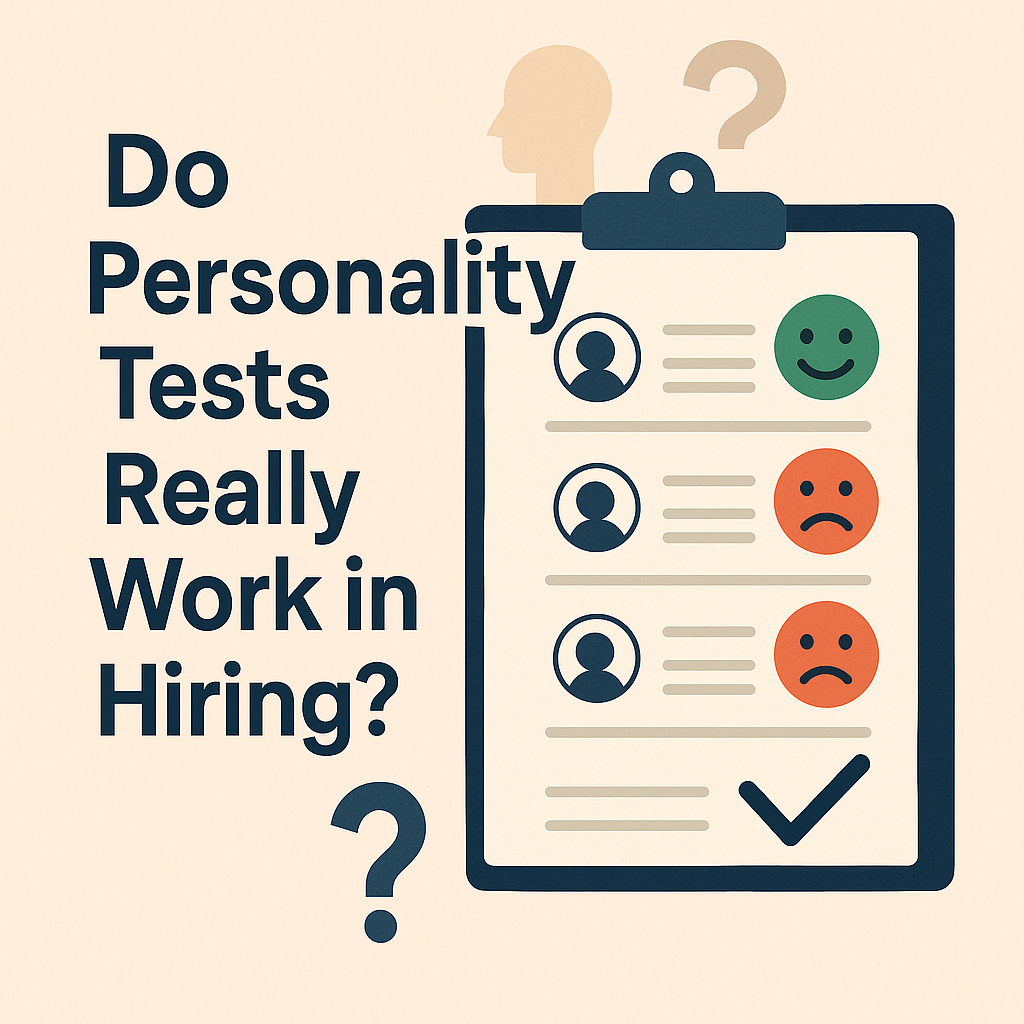
Personality testing has become big business. Today, it’s a £4 billion industry with over 1,300 tools available, and about 62% of HR departments rely on it as part of their selection processes. But the central question remains the same as it was decades ago: Does it work?
As Peter Cappelli has pointed out, the predictive validity of these tests—the very foundation of whether they can forecast future performance—remains unresolved. Instead of asking whether personality testing works universally, perhaps the more useful question is: Which tests work, in which situations, and for what purposes?
This is not an abstract debate. Personality assessments influence high-stakes decisions, shaping careers, organizational dynamics, and even personal identities. And yet, the evidence is mixed.

A Brief History of Personality Testing
The fascination with personality assessment is hardly new. It stretches from ancient attempts at character judgment, through pseudoscientific phases like phrenology and early psychoanalytic theories, to today’s psychometric frameworks such as the Big Five.
After a lull in the mid-20th century, meta-analyses in the 1960s and beyond revived interest by claiming modest correlations (r = 0.15–0.30) between traits—particularly conscientiousness—and workplace outcomes. But even those claims were not without criticism: small sample sizes, inflated supervisor ratings, and applicant faking all cast doubt on reliability.
The Challenges
Several recurring issues keep personality testing controversial:
- Faking & self-deception: Self-report measures remain vulnerable to intentional impression management and unconscious biases.
- Context blindness: Many validation studies ignore how personality interacts with situational dynamics in real work environments.
- Bias & fairness: AI-driven scoring tools have shown biases that disadvantage certain groups, raising ethical and legal concerns.
- Narrow focus: Most tools emphasize the “bright side” of personality, while underestimating “dark side” derailers that can harm leadership effectiveness.
- VUCA complexity: In volatile, uncertain, complex, and ambiguous contexts, linear correlations between traits and performance break down.
At worst, misuse of personality testing can perpetuate discrimination, erode trust, and reduce selection to box-ticking exercises rather than meaningful insights.
Future Opportunities
Despite these challenges, I believe there is still promise—if personality testing evolves responsibly. Some promising directions include:
- Contextualization: Tailoring tests to specific roles and industries rather than applying one-size-fits-all models.
- Integration: Combining self-report measures with objective data sources (e.g., digital footprints, behavioral analytics).
- Inclusivity: Expanding research beyond WEIRD samples (Western, Educated, Industrialized, Rich, Democratic) to reflect global diversity.
- Depth: Exploring projective methods or hybrid models that go beyond surface traits to reveal deeper drivers.
- Humility: Shifting from inflated claims to an honest recognition of what tests can—and cannot—predict.
Closing Thought
Personality testing sits at a crossroads. Used wisely, it can enrich hiring and development by providing structured insights into how people may show up at work. Used poorly, it risks reducing human complexity to simplistic labels.
For leaders and organizations, the challenge is not to chase the newest tool or trend, but to ask: How do we integrate personality insights in a way that is fair, contextual, and truly useful for decision-making?
Done right, personality testing can move from controversy to credibility—and become a force for more equitable and effective workplaces.
👉 What’s your view? Do personality tests help us make better hiring decisions—or do they create more noise than clarity?