
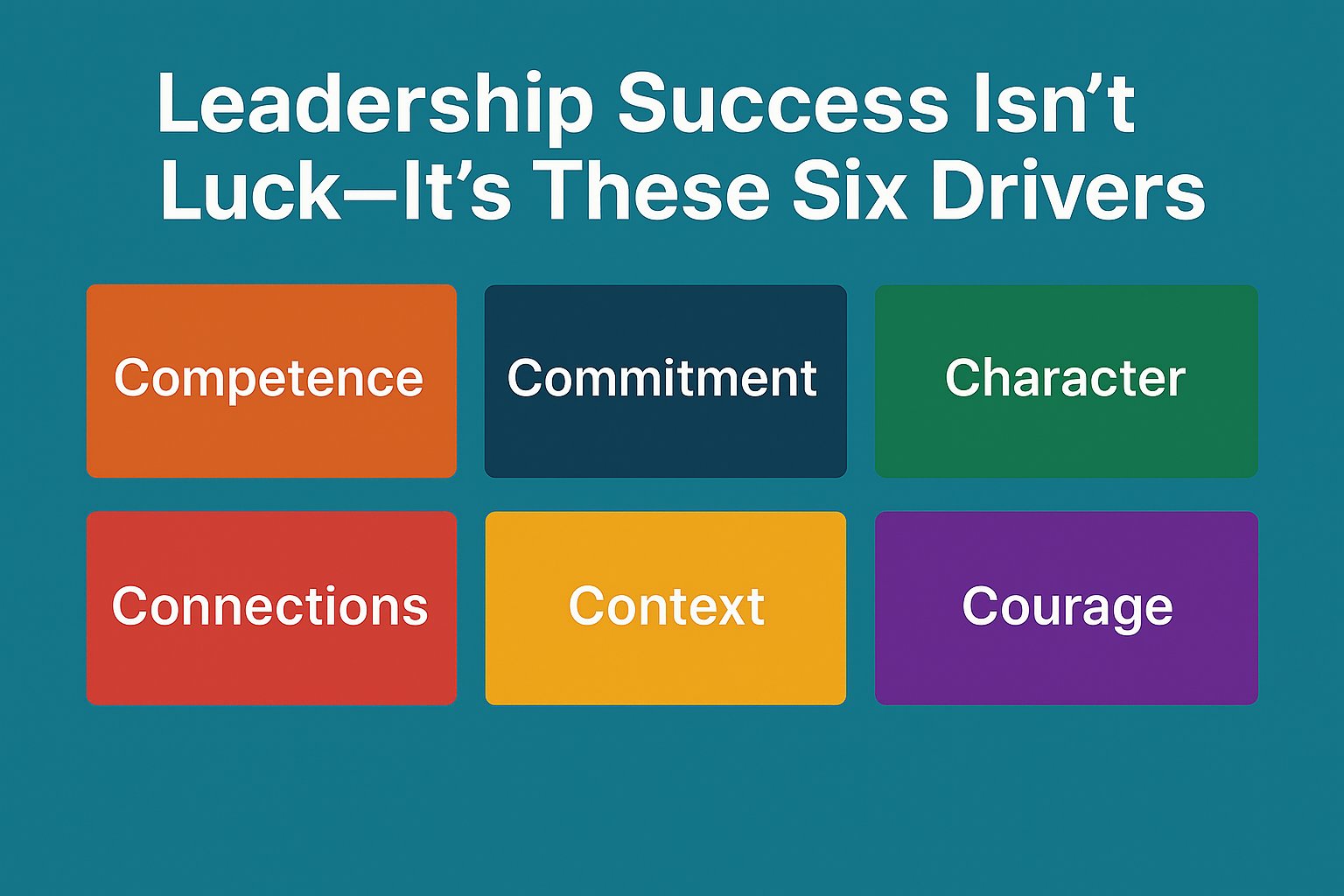
When we think about leadership success, it’s tempting to default to the “talent + luck” formula. Talent matters, of course—but relying on it alone leaves leadership outcomes fragile and unpredictable.
To build a robust success framework for selection, development, and succession, we need to expand our lens. Leadership today is not just about what an individual brings—it’s about how their skills, drive, and integrity interact with their networks, environments, and capacity for bold action.

Here are six key drivers that together create a fuller, more predictive picture of leadership impact:
1. Competence
Core skills and knowledge remain the foundation of performance. Leaders must have the technical expertise and problem-solving ability to meet the demands of their role. Without this baseline, other qualities cannot compensate.
2. Commitment
Motivation and sustained effort separate consistent performers from those who fade under pressure. Research shows that 70% of engaged leaders outperform their peers (Deloitte, 2023). True commitment is fueled not only by external rewards but by intrinsic passion and resilience.
3. Character
Integrity, humility, and emotional stability underpin trust. When leaders demonstrate ethical consistency and the ability to manage stress effectively, they reduce derailment risks by 25% (DDI, 2022). Character remains the invisible force that either stabilizes or destabilizes leadership performance.
4. Connections
No leader succeeds in isolation. Strong networks amplify influence and broaden impact. Leaders who build effective cross-functional ties and mentorship relationships drive 20% higher productivity in their teams (Corporate Leadership Council). Connections are the multiplier of leadership reach.
5. Context
A leader’s success depends not only on their traits but on the environments in which they operate. A 30% swing in performance has been observed across different settings (Harvard Business Review, 2023). Leaders who adapt to shifting contexts—stable or disruptive—are the ones who remain relevant.
6. Courage
Finally, leadership requires boldness. The willingness to challenge norms, embrace calculated risks, and innovate propels organizations forward. 35% of top leaders cite courageous decisions as critical success factors (McKinsey, 2024). Without courage, even competent leaders stagnate.
Putting the Six Drivers into Practice
How do organizations move from theory to action?
- 360-degree feedback can surface insights on competence, commitment, and character.
- Network analysis tools reveal the strength and reach of connections.
- Scenario planning and simulations help assess context sensitivity and courage.
Most importantly, these drivers must not be assessed in silos. Leadership effectiveness emerges from their integration.For example, one tech firm that aligned development programs with all six drivers saw an 18% rise in leadership retention by tailoring growth paths to contextual shifts.
The Takeaway
Leadership is not luck. It is a system that can be intentionally nurtured. By embracing these six drivers—competence, commitment, character, connections, context, and courage—organizations can future-proof their leadership pipelines and foster resilient, high-impact teams.
The question is no longer “How talented is this leader?” but rather “How well does this leader integrate all six drivers to create lasting impact?”