
As an Executive coach, I often ask my clients two simple but revealing questions:
What has truly shifted for you? And who around you has noticed the difference?
Over time, the patterns have been remarkably consistent. Across industries, leadership levels, and diverse contexts, the same transformational shifts keep emerging. Different people, different challenges — yet similar inner movements.
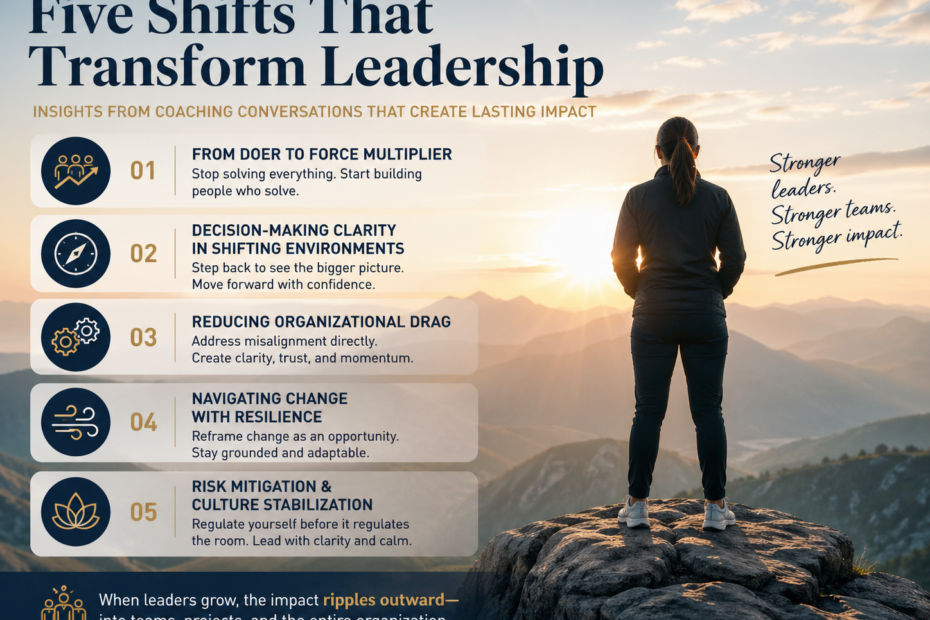
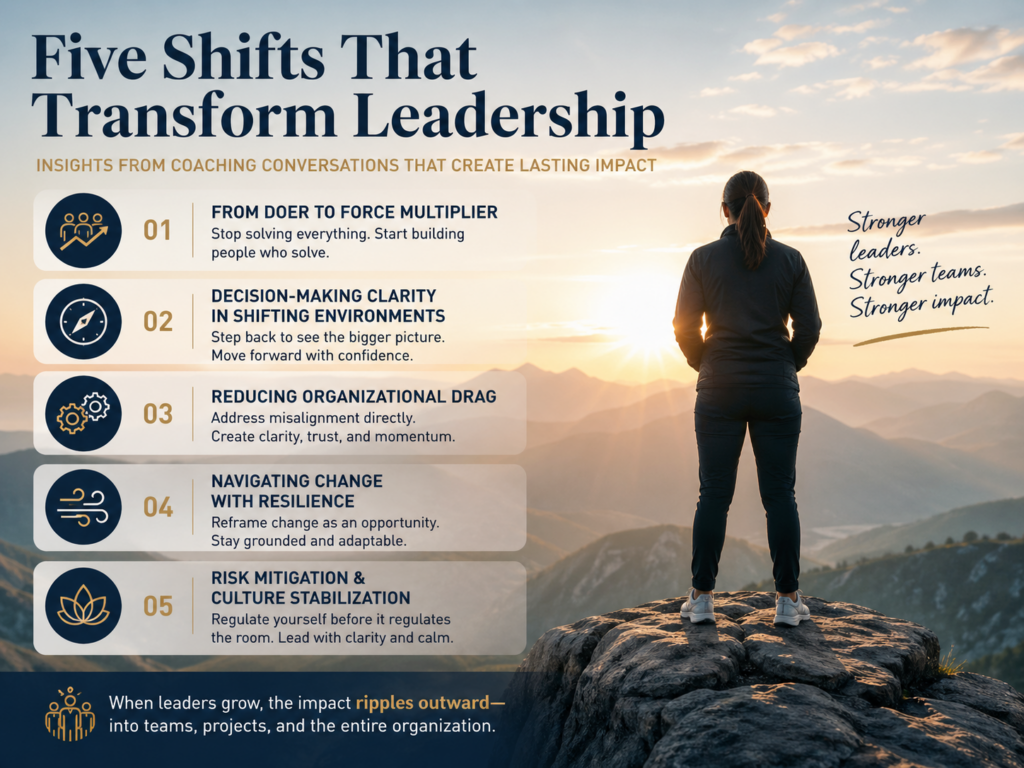
These are five shifts I hear most often in coaching conversations.

1. From Doer to Force Multiplier
Many of my clients have built successful careers by being excellent problem-solvers. They step in, fix issues, and carry responsibility well. Yet at a certain stage, constantly being the answer can become the very thing that limits their leadership.
A question I often explore with clients is:
What changes when you stop being the one who solves everything and start developing others who can?
This is often where a profound shift happens — from heroic individual contribution to multiplying the capacity of others.
When clients make this shift, teams begin operating with greater ownership. Decisions move faster. Trust deepens. Leadership becomes less about carrying more, and more about enabling more.
2. Decision-Making Clarity in Complexity
Many leaders I coach wrestle with the tension between acting too quickly and overanalyzing until momentum stalls.
A question I often pose is:
How do you create enough pause to see clearly, while maintaining the courage to move forward?
Through coaching, many clients strengthen their ability to hold perspective before reacting — to make decisions grounded not in urgency, but in discernment.
What often follows is greater confidence, steadier momentum, and decisions that endure.
3. Reducing Organizational Drag
Another recurring theme in coaching is what I call organizational drag — the friction created by avoided conversations, unclear expectations, or misalignment left unattended.
I often ask:
Where are you accommodating friction instead of addressing it?
That question can unlock powerful awareness.
As clients become more direct, clearer in feedback, and more intentional in conversations, relationships often improve rather than deteriorate.
Projects move again. Collaboration strengthens. What was once draining becomes generative.
4. Navigating Change with Resilience
Much of executive coaching today sits in the context of constant change — restructures, uncertainty, evolving roles.
A question I often hold with clients is:
What if change is not something to resist, but something inviting a new response from you?
That reframe can be transformative.
I often see clients move from reacting to disruption… to engaging change with perspective, steadiness, and even possibility.
And when that happens, their teams often mirror that stability.
5. Leading Through Inner Stability
One of the deepest shifts clients often describe is learning that leadership presence begins with self-regulation.
I frequently ask:
What happens in the room when you regulate yourself before responding?
That question opens profound work.
When leaders learn to slow down, respond rather than react, and stay anchored under pressure, the ripple effect is tangible.
Less tension. Less unnecessary drama. More trust. More clarity.
Why These Shifts Endure
What I’ve observed is that these are not simply skills clients acquire. They are leadership capacities they grow into.
They reshape how leaders perceive complexity, engage others, navigate uncertainty, and show up under pressure.
Some strengthen systemic thinking.
Some deepen collective leadership.
Some cultivate self-evolution.
Together, they create something larger than performance improvement — they create transformational impact.
And perhaps what matters most:
When these capacities strengthen in one leader, the growth rarely stays with them.
It ripples outward — into teams, cultures, and the wider system.
That, to me, is where coaching becomes more than development.
It becomes transformation.