
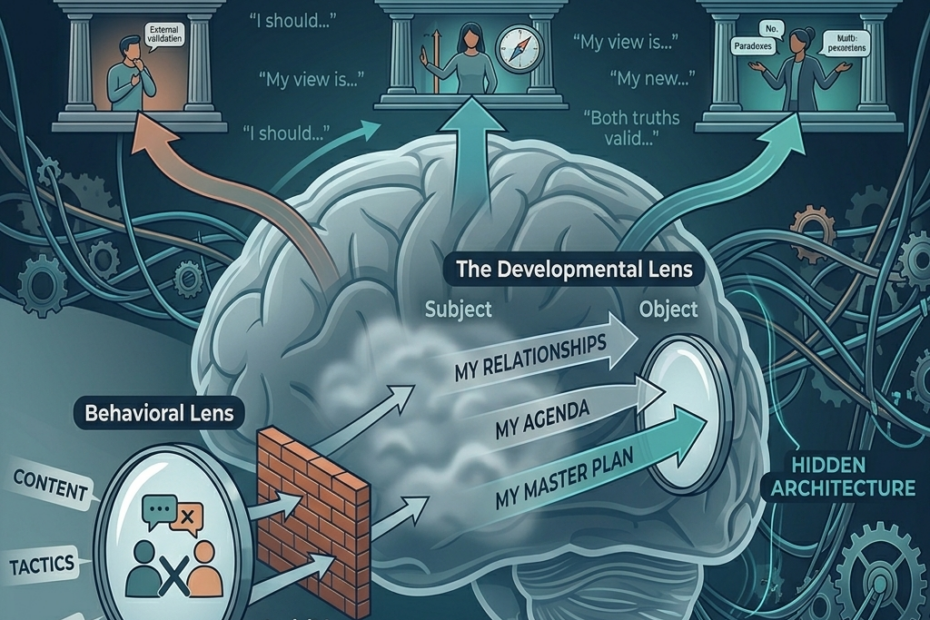
Every leader we coach eventually hits an invisible wall that behavioral fixes simply cannot scale.
As executive coaches and consultants, we are intimately familiar with this loop. A client comes to us with a concrete, recurring workplace frustration. They are brilliant, driven, and possess a stellar track record, yet they find themselves trapped in an exasperating behavioral pattern. Our immediate consulting instinct is often to reach into our toolkit for practical strategies, communication scripts, or structured roleplay exercises.
But what if the roadblock isn’t a lack of skill, executive presence, or tactical preparation? What if the block is the very psychological lens through which the leader interprets their reality?
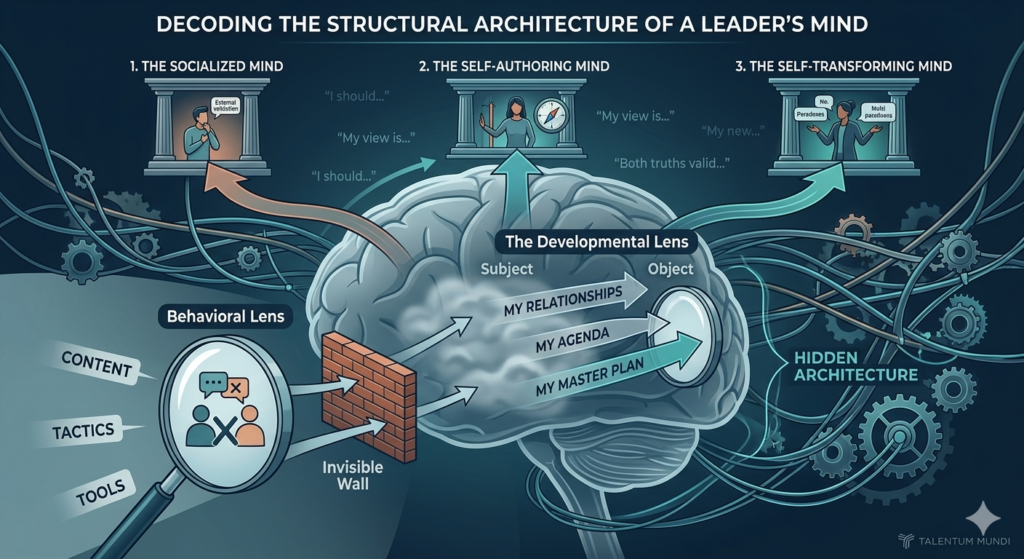
To unlock true, sustainable transformation, we must look past the content of our clients’ stories and start listening to the hidden architecture of their minds.
The Trap of Behavioral Fixes: A Tale of Three Lenses
Consider a scenario involving Elena, a Vice President of Product Strategy at a fast-growing enterprise software firm. Elena is managing a high-stakes, cross-functional digital transformation project. She is deeply motivated, technically sharp, and eager to deliver massive organizational impact.
She spends weeks aligning with engineering, synthesizing market data, and building a flawless, airtight strategic recommendation for the executive committee. But during the alignment meeting, the Chief Technology Officer, Marcus, pushes back heavily on her timeline.
In that exact moment, something internal short-circuits for Elena. She completely drops her hard-earned position, defers entirely to Marcus’s alternative timeline, and retreats. Later, when reflecting on the meeting, she realizes she has lost her internal compass—she can no longer objectively evaluate if her original roadmap was actually the right choice.
If you were coaching Elena, how would you approach the problem? Let’s look at how three different coaches might interpret the exact same scenario:
- Coach A (The Behavioral Lens) sees a tactical breakdown. He notes that Elena struggles to hold her ground under executive pressure. He offers actionable tools: “Let’s commit your recommendation to a slide deck beforehand,”and “Let’s do a mock alignment meeting where I play Marcus.”
- Coach B (The Insight Lens) believes Elena already holds the keys to her breakthrough. She asks reflective questions: “What do you think is really driving your reaction in those moments?” and “What would it look like to step fully into your own data-driven clarity here?”
- Coach C (The Developmental Lens) listens closely to how Elena reflects on the breakdown. He observes: “Your roadmap didn’t suddenly become poor strategy the moment you walked into that room. Something shifted inside you when challenged. That’s a developmental edge, not a capability issue.”
If we track the long-term outcomes, Coach A’s tactical tools will likely fail because Elena’s issue isn’t a lack of preparation or strategic skill. Coach B’s insightful questions will yield wonderful clarity within the safety of the coaching session, but that clarity will evaporate the moment Elena steps back into the real world and faces Marcus’s pushback.
Only Coach C notices what is truly happening. He sees that Elena can generate a clear, independent perspective when she is in her own workspace, but she cannot yet sustain it when it collides with a competing view from a high-status stakeholder whose validation matters to her.
Constructive-Developmental Psychology: Subject vs. Object
To understand why Coach C’s approach creates lasting, structural change, we have to look at the core of Constructive-Developmental Psychology, a field pioneered by Harvard developmental psychologist Robert Kegan and his long-time collaborator Dr. Lisa Lahey.
This framework rests on two profound premises:
- Constructivism: We do not live in an objective reality. We live in our interpretation of reality. We actively construct our understanding of the world.
- Developmentalism: The internal mental forms we use to construct our world are not fixed. They can grow increasingly complex, expansive, and well-integrated over the course of our adult lives.
At the heart of this adult growth is the shift from Subject to Object.
Subject refers to the elements of our psychological experiencing that we are fused with, look through, and cannot see. Because we cannot see them, they run us completely.
Object refers to the elements of our experiencing that we can step back from, look at, reflect upon, and operate out of. Because we can see them, we gain true agency over them.
Psychological development is the continuous process of making what is Subject into Object. Growth occurs when we take the hidden lenses that dictate our automatic behaviors, place them on the table in front of us, and evaluate them objectively.
The Three Adult Mindsets
In adult development, there are three distinct structural plateaus, or internal operating systems, that dictate how leaders make sense of reality, authority, and workplace conflict.
1. The Socialized Mind
A leader operating primarily from a Socialized Mind is psychologically fused with their environment. Their identity is completely shaped by the expectations, beliefs, and feelings of the people, teams, or institutions around them.
They do not have a distinct, independent internal home; they live in the house built by their relationships. Their primary psychological directive is alignment, loyalty, and inclusion.
- Workplace Impact: They are highly dedicated team players and excellent context-trackers. However, they face a critical leadership vulnerability: they can become organizational chameleons. Because they look to authority or the collective to know what to think, they struggle to hold a steady strategic vision under pressure. Conflict feels like an existential threat to their safety and connection.
2. The Self-Authoring Mind
A person who has transitioned to a Self-Authoring Mind has successfully made external expectations Object. They have built their own independent internal psychological “house,” complete with its own values, boundaries, and internal operating manual.
They no longer look to authority to know what to think; instead, they possess an internal compass that filters external data through their own criteria.
- Workplace Impact: These are autonomous, self-directed leaders who can confidently take a stand, manage firm boundaries, and execute an independent agenda. Their vulnerability, however, is rigidity. Because they are fused with their own self-authored system, they can become defensive or blind to alternative viewpoints, treating their strategic vision as the absolute truth.
3. The Self-Transforming Mind
At this advanced plateau, the leader has made their own self-authored system Object. They can step back and look at their own master plan, recognizing that it is inherently limited, incomplete, and just one perspective among many.
- Workplace Impact: These leaders thrive in highly complex, volatile, and ambiguous (VUCA) environments. They do not need a single “right” answer to feel secure. They speak in nuance and paradox, leaning into tension and conflict not to defend their position, but to evolve the entire system.
Reading the Signals in Corporate Coaching
As executive coaches, our job is to listen past the business problems our clients present and decode the structural mindset speaking. We can do this by tuning our ears to the specific linguistic and psychological signals of each plateau:
| Professional Axis | The Socialized Mind | The Self-Authoring Mind | The Self-Transforming Mind |
|---|---|---|---|
| Linguistic Clues | “I should,” “I’m supposed to,” “They expect me to…” | “My view is,” “According to my plan,” “I choose to…” | “I hold this perspective strongly, but I want to find my blind spots.” |
| Primary Focus | Relationship & Inclusion:Managing connections and tracking perception. | Agenda & Autonomy: Executing their master plan and maintaining control. | Interdependence & Growth:Evolving the system and learning through tension. |
| Response to Feedback | Experiences it as a direct verdict on their personal worth or group membership. | Treats it as information to be filtered, accepted, or rejected by their own criteria. | Actively craves challenging feedback as vital data required to expand their thinking. |
| Handling Conflict | Avoids or accommodates.Friction threatens psychological safety. | Competes or manages. Seeks to override or compartmentalize the friction to stay on track. | Embraces and integrates. Uses the conflict as a creative generator for higher-level synthesis. |
Re-diagnosing Elena: The Developmental Edge
With this framework in mind, we can see exactly why Elena was stuck. Elena is standing squarely on The Transitionbetween the Socialized Mind and the Self-Authoring Mind.
When she is working alone in her office, her emerging Self-Authoring spark allows her to generate an independent, rigorous roadmap. But the moment an authority figure like Marcus pushes back, her Socialized operating system hijacks her. Because her identity is still subject to the approval of authority, her internal certainty evaporates.
Elena’s back-and-forth shifting isn’t a behavioral flaw, a lack of confidence, or an inability to lead. The oscillation is the developmental work itself taking place. Her internal system is actively trying to grow.
Coach A’s behavioral coaching failed because it assumed Elena already possessed a fully functioning Self-Authoring mind and just needed better tactics. Coach B’s coaching failed because it assumed she could easily access a “gut” that physically disappears under pressure.
Coach C’s coaching succeeded because he named the structural pattern. By saying, “Something shifted inside you when challenged,”, he helped Elena pull her socialized fear out of her subconscious and place it on the table. He made her need for approval Object, allowing her to look at it rather than blindly reacting from it.
Action Plan for Developmental Coaches
If we want to elevate our coaching practice to help clients navigate these profound structural shifts, we must transform our own listening and intervention strategies.
1. Shift Your Listening from Text to Subtext
When a client presents an organizational problem, resist the urge to immediately brainstorm solutions. Ask yourself:
- What is running this client right now?
- Are they speaking from a place of needing approval (Socialized), needing control (Self-Authoring), or needing to defend their ideology?
- What are they subject to, and what can they actually hold as object?
2. Calibrate Your Interventions to the Client’s Developmental Edge
Match your coaching style to the client’s current structure while gently nudging them toward the next plateau:
- For a Socialized Mind: Do not just give them behavioral scripts. Help them identify their independent perspective and notice when and why that perspective vanishes in the presence of authority.
- For a Self-Authoring Mind: Do not just validate their brilliant plan. Gently challenge their certainty by asking them to identify the limitations or blind spots of their own system.
3. Avoid Replicating the Client’s Pattern
Be highly mindful of the coaching dynamic itself. If you are coaching a client with a Socialized Mind, they will instinctively look to you for validation and direction. If you tell them what to do, you become the new authority figure running their system, reinforcing their dependency. Like Coach C, explicitly name the pattern and hold a firm, supportive space that requires the client to step into their own authority.
True leadership transformation is never about adding more skills to an outdated operating system. It is about evolving the operating system itself. When we change the way we look at our clients’ challenges, we change what our clients are capable of seeing—and that is where genuine growth begins.